
|
In January, Guided Chaos founder John Perkins spent a week in South Florida, hanging out with and training me and fellow students.
Over the last six months or so, I’ve heard some folks wonder about John’s teaching and combative skills as he ages, and question whether he has the desire and energy to continue to teach Guided Chaos at all levels. Personally I never gave such doubts much credence, but given I’ve gotten to work with John only a few times per year since I moved to Florida in 2014, I’m hardly an authority. After John’s January visit, I can confidently state:
My students and I are still unpacking everything John shared and applying it to our training. From such a limited amount of training time while John was here, it’s amazing just how much there is to explore! The below list won’t even begin to capture the subtleties John explained and demonstrated, but hopefully can serve as a reminder in the future. A lot of these ideas may not appear to be “new,” and indeed John has been teaching all of this consistently for decades, but for me at least a lot of new light bulbs came on and new ways of thinking about things manifested in improved movement and capability.
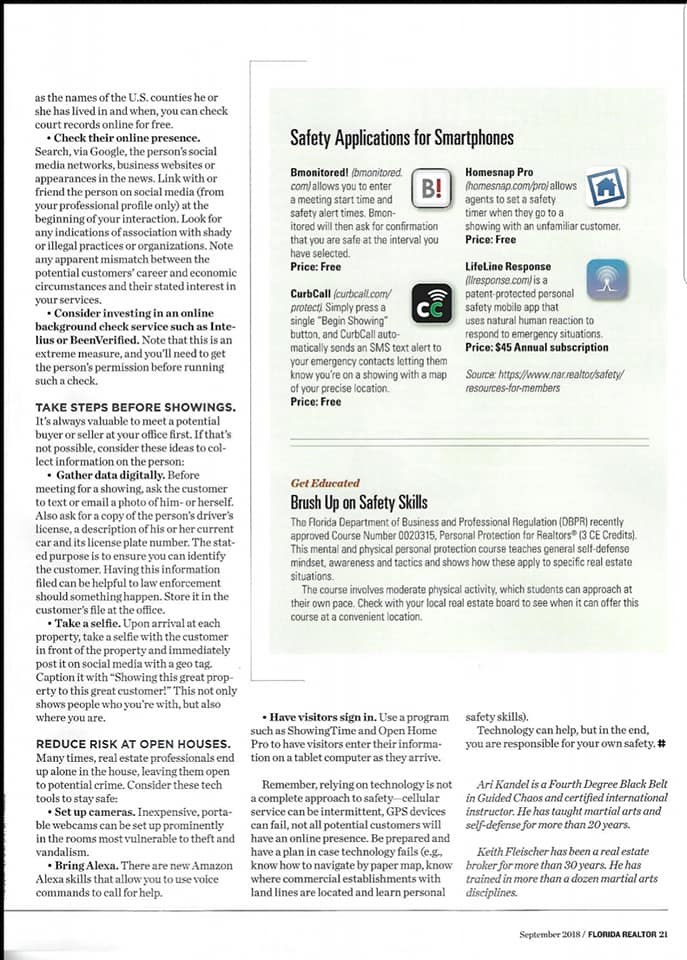
What can I say? If you want to improve, just get off your butt and train with John whenever you can. It may not always be what you expect or what you THINK you need, but in my experience (this year and the 15 years before), it will be what you ACTUALLY need, and a hell of a lot of fun too! Thank you John, and see you soon in NY! Welcome Guided Chaos founder John Perkins to sunny South Florida! John will be around for three weeks, enjoying time with friends and students. Contact us if you want to hang out! Realtor Safety: It’s All On You! Realtor safety can be greatly enhanced by institutional and procedural measures. Offices can leverage technology and best practices to greatly reduce risks to their realtors. Federal and State laws and professional regulations could help a bit in some cases. However, the safety of each individual is ultimately each individual’s responsibility. Regardless of procedures and regulations in place, you can’t depend on the care and competence of others when it comes to your and your family’s safety. You must realize that no one will come to save you in time, and no one will offer you a personal invitation to make changes that need to be made in your life. This, of course, is true for all people, not just realtors. Statistically, the greatest threats to your safety are: 1) Poor physical health 2) Poor mental health 3) Traffic accidents 4) Violent crime Here are some things you (and only you) can do to reduce risk and improve your own safety: 1) Physical Health The science at this point is conclusive that an individual’s risk of falling victim to the leading causes of death in the U.S. can be greatly reduced by a) maintaining a healthy weight and body composition, b) consistently getting sufficient sleep, c) eliminating unhealthy habits like smoking, drug addiction and excessive alcohol consumption, and d) moderately exercising the body. Body weight and composition are determined mostly by diet and hormone balance (which can be affected by sleep, stress and other factors). While many different theories persist about exactly what constitutes a “healthy diet,” and different bodies may respond differently to various foods and chemicals, current general consensus is that one should: a) minimize consumption of refined sugars (by any name, such as corn syrup and anything “dext,” such as dextrose or maltodextrin), simple carbohydrates and highly processed foods, b) maximize consumption of fresh vegetables, c) maximize hydration d) avoid overeating. If significant body fat loss is needed, more extreme measures may be necessary. Of course, consult your physician before implementing any radical dietary changes. Sufficient high quality sleep is critical to overall health, and most of us don’t get it consistently. While some people may seem to require more or less sleep than others, structuring your schedule to provide the opportunity for 7-8 hours of high quality sleep per night is advisable. Insufficient or low quality sleep can affect hormone balance (which can affect body composition and other physical and mental factors), mood and general efficacy, and can increase the risk of accident and injury. If you consistently get sufficient hours of sleep but still feel tired during the day, you should consult your physician about possible sleep disorders such as sleep apnea that could be negatively impacting the quality of your sleep. If you are addicted to recreational drugs (including tobacco products and alcohol), it is difficult or impossible to maintain reasonable physical and mental health. There are many resources and programs available to help you break these addictions. The most effective generally include some form of long term accountability. Making other healthy adjustments in your life can make it easier to break these addictions. Consult your physician for direction and advice. Physical exercise, while less critical to body composition than diet and hormone balance, is nonetheless essential for maintaining reasonable physical health. Extreme levels of strength, endurance and flexibility are not necessary to minimize prevalent physical health risks (in fact, training for them could introduce other risks, such as injury), but frequent and consistent movement of the whole body throughout its normal range of motion is needed to maintain healthy function. Moderate cardiovascular (e.g. walking or jogging), resistance (e.g. weights or bodyweight exercises) and mobility (e.g. stretching) training should be included. Practices such as Yoga, Pilates, swimming, martial arts and most sports typically integrate what’s needed for long term physical health. Of course, consult your physician before implementing any radical physical activity changes. A busy realtor’s lifestyle, including irregular schedules, travel and events where menu choices and timetables may be outside of the realtor’s control, may not be conducive to easily implementing healthy habits. Planning and preparation may be required to ensure daily access to healthy food and avoidance of circumstances that might lead to unhealthy practices. Disciplined time management can usually liberate sufficient daily opportunity for moderate exercise, sufficient sleep and other boons to physical health. 2) Mental Health Mental health (including stress management) is often neglected compared to physical health. However, considering suicide is one of the top 3 causes of death for Americans ages 15-54, it certainly warrants consideration! Your mental health, including how you experience stress, can affect all other areas of your life and wellbeing. If you consistently feel depression or anger, or your decisions consistently negatively impact your life or the lives of those around you, don’t hesitate to seek help. Likewise, if your doctor, a significant other, friends or coworkers suggest seeking help, don’t ignore their suggestions. A realtor needs to be able to navigate stressful situations gracefully, and spread and attract positivity to and from others. The challenges and uncertainties of the job can make this difficult, especially if other life circumstances introduce additional stressors. Seeking help is not acknowledgement of defeat or weakness, it is judiciously using all tools at your disposal to be as effective and successful as possible. 3) Road Safety Traffic accidents are a leading cause of death, particularly for Americans age 15-44. While up to 93% of Americans consider themselves “above average” drivers, the fact is the roads are plagued by potentially lethal distractions and carelessness. Considering how much time realtors spend driving, road safety warrants special consideration. While it may be unrealistic to advise that realtors conduct no business while driving, every possible step should be taken to minimize potential distractions. Hands-free and eyes-free cell phone operation is critical. While communication from the road may be necessary, be sure to set aside non-driving time to look at listings, review social media, etc. Keep your vehicle in good shape and always use it, rather than getting into a client’s car and trusting an unknown driver. Drive defensively and deferentially, as you never know how anyone else on the road may react to a perceived slight. Leave more than enough time to reach any destination, including traffic delays, so that you don’t end up rushed and distracted. Keep paper maps (which you know how to use) and emergency equipment and supplies in your vehicle at all times. Plan routes ahead of time, even if you use a GPS. If you are very tired or otherwise impaired, stay off the road, for your own safety as well as that of others. Anticipate any situation that could cause distraction while driving, and plan ahead to obviate it. A defensive driving course and more advanced driving courses are usually good investments, and may be fun as well! 4) Personal Protection While the reported violent crime rate in the United States has declined over the last three decades, lifetime likelihood of violent victimization is estimated to be well over 50%. (It was 83% in 1987 according to a landmark Bureau of Justice Statistics study.) While being a realtor may not be as risky as being a police officer or armored car security guard, realtors must daily put themselves in situations that most people would just as soon avoid. A realtor’s professional information and image is advertised to the public. Meeting relatively unknown and unvetted people and spending a lot of “alone time” with them in a variety of locations is a basic element of the career. According to the Bureau of Labor Statistics, an average of 75 realtors were murdered per year between 2003 and 2009. In some cases, serial killers specifically targeted realtors, circling their photos in advertisements and easily arranging to isolate them. According to the National Association of Realtors 2017 Member Safety Report, nearly 40% of realtors “experienced a situation that made them fear for their personal safety or safety of their personal information.” Rigorous safety practices in realtor offices can help reduce this risk. These include avoiding having realtors operate alone, thorough vetting of prospects, requiring initial client contact and documentation at the office rather than in the field, etc. However, each individual bears primary responsibility for his/her personal protection. It behooves each of us to seek training to protect ourselves and our loved ones against violence. Unfortunately, not all training is created equal. Many martial arts and self-defense classes, while touting their effectiveness in advertising, may not provide the skills and knowledge necessary to deal with actual and threatened violence in the context of an average citizen and realtor. Exercise, competition and aesthetic efficacy does not necessarily equate to training the necessary mindset, awareness, subconscious reaction, strategy and tactics to help you avoid, deter and counter violent attacks. Fortunately, the Florida Department of Business and Professional Regulation recently approved Course Number 0020315, Personal Protection for Realtors (good for three continuing education credits). This mental and physical personal protection course teaches general self-defense mindset, awareness and tactics, and how these apply to the specific situations and risks inherent in the real estate profession. Students learn how to forge good habits to better assure safety while allowing focus to remain on the sale, and how to counter and escape an imminent threat. The course involves moderate physical activity, which students can approach at their own pace, regardless of fitness level. Check with your local real estate board to see when they can offer this course at a location convenient to you. Many people (including a disproportionately large number of realtors) purchase a personal protection tool, such as a handgun, Taser or pepper spray, and assume that the purchase alone fulfills their need for personal protection. Unfortunately, this is not accurate. It is true that a reliable tool in properly trained hands can greatly increase the effectiveness of that individual’s personal protection. However, basic training is still essential, both to reduce the likelihood of ever needing the tool, and to enable the individual to bring the tool into play effectively if and when appropriate. The Personal Protection for Realtors course broadly addresses use of personal protection tools and recommended paths for tool-specific training. Sources used in this article: http://www.worldlifeexpectancy.com/usa-cause-of-death-by-age-and-gender https://www.bjs.gov/index.cfm?ty=pbdetail&iid=3647 https://www.nar.realtor/2017-member-safety-report From September 2018 issue of Florida Realtor magazine, article by Keith and me. Aimed at realtors but may be helpful to others as well. Enjoy! 
A "Q&A" type article I did a few years back. Enjoy! https://guidedchaos.kartra.com/page/WingChunMagazineArticle HEADS UP OHIO!!! Sign up here for the Guided Chaos Focus Workshop I'll be teaching in CINCINNATI, SEPTEMBER 21-23, 2018. Internal drop hitting, subtle groundfighting, weapons defense, contact flow and more! Make sure to register before September to take advantage of the early registration discount. Looking forward to it! Check out https://arcanecane.com/products/arcane-cane-02 for the absolute best self-defense-oriented cane, and use code PRELAUNCH2018 for $10 off! Why? Here's why: "The advantages of a walking stick that you know how to use as a weapon are really amazing. Proficiency permits you to inflict severe injury without killing – and injury that produces pain beyond belief! Owning and carrying a walking stick is, as far as we know, legal virtually everywhere. The weapon is always in your hand. This makes it faster into action than a holstered gun under your coat, and faster than a knife that you must produce and open. The walking stick gives you reach, power, and the ability to use force up to and including deadly levels, should that become necessary (vs. a gang attack; a much younger, larger, stronger attacker; or knife-wielder, etc.)." --excerpted from the July 2018 edition of Bradley J. Steiner's monthly newsletter, "Sword and Pen," available on his website, americancombato.com. Also see here, and here. The writings of Bradley J. Steiner were a major influence on Guided Chaos founder John Perkins when John first started writing about and teaching self-defense martial arts. Mr. Steiner, an expert in armed and unarmed close combat, originally coined the phrase (in writing) "Attack the Attacker," a lynchpin of the strategy of both Steiner's American Combato system and Guided Chaos. To this day, Mr. Steiner's talent for using the written word to convey aspects of close combat and self-defense remains unmatched. The below article, which delves into the mindset requirements of dealing with pain and injury, is excerpted from the July 2018 edition of Mr. Steiner's monthly newsletter, "Sword and Pen," available on his website, americancombato.com. Enjoy! ONE fact about real world self-defense is that it cannot be undertaken risk-free, and frankly it is just about certain that in a truly dangerous encounter with one or more determined aggressors you will surely be hurt. Many schools of martial art apparently fill students’ heads with notions of invincibility, and fail to equip them for the realities of anything goes personal combat. We prefer to get all of our cards out on the table, as it were. Yes . . . we can and do teach the finest and most reliable methods of interpersonal mayhem (“self-defense” if you prefer) and if you become expert in our methods you will absolutely stand an excellent chance -- probably better than 95% -- of successfully stopping a violent attacker from injuring you badly, or from doing the same to someone you need to protect. But some injury is just about inevitable. If an attacker comes at you with a knife, he has the advantage. Do everything right and you stand a good chance of surviving and dropping the attacker; but if you escape without so much as a minor cut or a stab wound somewhere on your body -- requiring at least some out-patient care, and a dose of antibiotics -- then you can chalk the outcome up to LUCK. Excellent as our training is, we make no claims for its being miraculous! The wise student of self-defense and close combat expects to get hurt. Illusions of being some kind of superhero or “unstoppable warrior” must never be allowed to cloud a student’s mind. No matter how expert you are, no matter how strong you are, no matter what excellent level of agility and fitness you may enjoy . . . serious individual combat will almost certainly result in injury to yourself, should you ever be so unfortunate as to find yourself immersed in it. So here’s the big question: “Are you mentally conditioned for the reality of being hurt, when and if you undertake to defend yourself?" More: “Are you working at conditioning yourself so that your immediate reaction to being hurt in an encounter is one that actually enhances your chance of survival and victory?” There are two things that such conditioning requires:
You can do this if you work on it and at it in training! A quality teacher who knows what he’s about will help you greatly . . . but failing to have the good fortune of finding a qualified teacher, make up your mind to do this for yourself. While jungle beasts and other dangerous animals are programmed by Nature to be this way (for their survival) you will need to program yourself this way. And it is for your survival. Violent offenders are extremely dangerous. The shock, fear, or momentary disbelief that your being hurt can cause, will likely be the only opening your adversary needs to do whatever he wishes to you -- and it won’t be pleasant. On the other hand, if your reaction to being hurt is explosive rage and the ferocity and ruthless disregard for your enemy that this easily makes possible, then -- short of administering a knockout blow or lethal injury -- your assailant will almost certainly be triggering his own destruction when he hurts you. And that’s the way it should be. You want to react to your injury and pain in any dangerous encounter by:
Your attitude and mind-setting resembles, in this regard, that of not only a wild animal, but also of one of man’s most intelligent and highly trained best friends: the guard or protection dog. There have been cases where these marvelous protectors have absorbed five and six bullets, and kept right on coming until the enemy was destroyed! An intelligent, well-trained dog who is normally friendly and loving possesses the ability to shift into an attitude of terrifying, totally focused, unrestrained aggression . . . and to savage whomever he must in order to defend himself, his master, and home and hearth! We all can learn a lot from these great animals. And that’s our message: Be a realist. There are no supermen or unbeatable warriors. We are all human and we are all subject to injury. We must be conditioned to become as great, as severe, as instantaneous, and as dangerous a threat to any extralegal vermin who undertake to prey upon us, as a jungle cat. And we must expect to get hurt, and be conditioned ahead of time to react to being hurt exactly as the most dangerous wild animals on the planet react. One day you may owe your life to having absorbed this lesson. 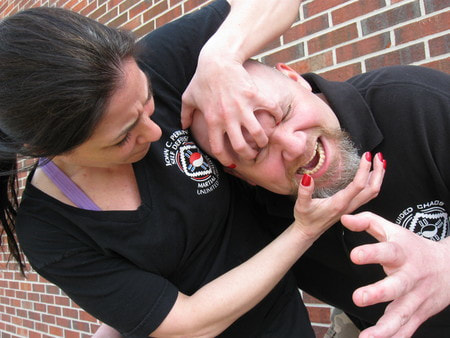 The writings of Bradley J. Steiner were a major influence on Guided Chaos founder John Perkins when John first started writing about and teaching self-defense martial arts. Mr. Steiner, an expert in armed and unarmed close combat, originally coined the phrase (in writing) "Attack the Attacker," a lynchpin of the strategy of both Steiner's American Combato system and Guided Chaos. To this day, Mr. Steiner's talent for using the written word to convey aspects of close combat and self-defense remains unmatched. The below article, which delves into the mindset requirements of the Attack the Attacker concept, is excerpted from the June 2018 edition of Mr. Steiner's monthly newsletter, "Sword and Pen," available on his website, americancombato.com. Enjoy! FAILING to avoid trouble the next best action is to preempt it. That is, ATTACK THE ATTACKER! which we first formulated as our basic strategy in American Combato in the early 1970’s, for anyone seeking self-defense instruction and training for the real world. OK . . . attack the attacker. Simply and plainly put, and easy to understand. The problem lies in the doing. That is, confronted by an obvious threat that will not go away and that you realize must be defended against ––– the sooner the better ––– the big question is: WILL YOU? For the typically decent individual it can be a tremendously difficult thing to “trip the wire” and take offensive action in self-defense. Nevertheless it must be done, and if you aspire to be able to handle real world dangerous violence you must learn to do it. Merely learning reliable attacks and attack combinations will not guarantee that you will employ them without hesitation if they are needed. This concept applies to weapons and unarmed combat. There have been people whose skills and in some instances whose armament was quite adequate to deal with a dangerous threat; but because these people were not sufficiently attack minded their potential for effective management of their crisis proved to be of no use. So how can you be assured that, should the worst happen, you will go into aggressive, ferocious, preemptive action? There is only one way: You require a made up mind, and a decision that is settled within you regarding what you will do if it ever happens “for real”. “If I am placed in a dangerous situation where violence against me or those I love presents itself, then I am going to render that threat harmless. I will attack and keep on attacking until my enemy has lost the will and the capacity to cause me or mine any harm.” Read that above statement a few times. “Feel” its meaning. Get with it. That is what must become your inviolate decision, made well ahead of time ––– right now, in fact! ––– so that there is no need to argue with yourself, equivocate, hesitate, consider, or otherwise delay a millisecond in a real situation. This is not a trivial point. Virtually no instructors that we ever had (save three) ever addressed this point ––– and they did so indirectly. We believe that it should be brought out clearly and deliberately, stated firmly, and PUSHED to the Nth degree in mentally conditioning our students. It is too vital to be left to chance. We are confident that our teachings ––– in person, and via such medium as DVDs and CD publications, etc. ––– go to essentially good people who have no evil desire to harm anyone, but who merely wish to have a high level of competency in self-defense. Our understanding of such people (whom we have been teaching for well over 50 years) is that their essential decency and reasonable lifestyle makes for a possible mental block against violently harming another human being. That’s simply got to go. When a crisis strikes you cannot see “another human being”, but instead must realize that this scum before you will happily beat you, stab you, shoot you, stomp you, or do whatever its deplorable excuse for a “mind” enjoins it to do. It is not fully human, it is not at all civilized, and when it decided to be a predator it gave up any rights to being treated with anything but ruthless disregard and brutality. NOW GIVE IT WHAT IT DESERVES AND DO NOT LET YOURSELF OR ANYONE YOU LOVE BE VICTIMIZED BY THIS CRAWLING EXCREMENT! These are the things that should be pounded again and again and again into your head by a qualified teacher, or ––– if you either train in a less-than-fully-adequate combat system, or on your own with DVD and book instruction ––– by you, yourself! Your goal is simple, legal, honorable, moral, and by any rational standard, reasonable: It is to be 100% prepared to dish out the most fiercely merciless brutality when one or more extralegal pieces of s–––t decide that you or someone you love will be their next victim. You want to be prepared always, during your normal daily activities of work, school, recreation, family time, whatever, to turn into a vicious warrior ––– a merciless savage who is capable of meeting the worst and most dangerous violent garbage that may come at him from amongst the dregs of the society in which he lives. We hope that you get this message. In those cases where intended victims of violence exploded with fierce action and the will to destroy their victimizers, they did just fine! The sewage does not expect that its intended prey will be able to offer much if any resistance. Otherwise, the sewage would look for another person to attack. So, thank God you will have the advantage of surprise, which as any military tactician knows is more than half the battle won, if the appropriate use is made of that advantage. Please . . . for your sake and for the sake of anyone dear to you, take this to heart. Decide. Decide now and decide with all of your heart, soul, and mind, that if you ever find yourself (possibly, if you ever again find yourself ––– because we know that former victims of violence are among those who come to us for training) in a situation where scum has intruded upon your existence and threatens to maim or to kill you, it will be you who makes that vital first, preemptive move ––– and you will crush that evil bastard like a used paper cup! You can do it. Just make up your mind that you WILL do it.  |
Archives
July 2023
Ari Kandel
Guided Chaos Instructor Categories
All
Categories
All
|
||


 RSS Feed